This website uses cookies. Find out more in our Privacy Policy.
Kathy Araujo Hernandez '26
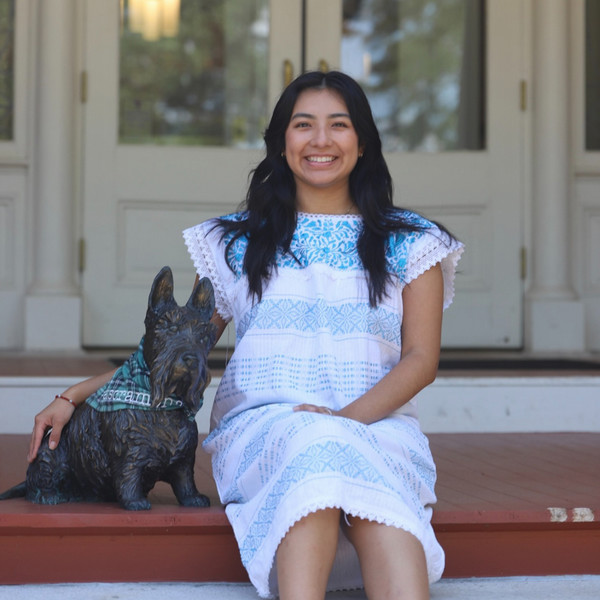
Kathy Araujo Hernandez ’26
It’s no secret that many people believe taking a gap year before starting college results in not attending at all. Kathy Araujo Hernandez ’26 did not begin college immediately following high school because it did not feel like a realistic option. Instead, she turned to a warehouse job working alongside her dad. Then she discovered the Goizueta Foundation Scholarship, and knew if she could be awarded that kind of financial support, the trajectory of her life would change.
“I was offered full scholarships at three different schools,” Hernandez said. “Agnes Scott College hooked me on the campus visit. It’s close to home, but it’s not too close to home—-I wouldn’t need to fly to see my family. The campus is beautiful, but more importantly, the people are welcoming and know you. I felt like I was already a part of the campus even before enrolling.”
Hernandez participated in a computer science program throughout high school, but often felt like an outlier because she was the only female in the program. The exclusion she felt in that program was the kickstart to pursuing a women’s college, which quickly proved to be the right decision—-within weeks, she had found a roommate via social media and she arrived to campus in August with a built-in sense of belonging. Support did not just come from her peers, but from college staff as well.
“I always wanted to dance ballet,“ Hernandez said. “I’ve done some traditional Mexican dancing, but I always wanted to try ballet. My Summit advisor was like, ‘Well, we have a class for that. Do you want to try it?’ I felt seen, and I got to chase a hobby.”
Soon enough, Hernandez learned that she had the flexibility to pursue various interests. At Agnes Scott, students do not declare their major until sophomore year—even if they arrive with a major in mind. This practice allows for exploration in a space that belongs entirely to the student. Hernandez initially enrolled planning to pursue a psychology major. She did, but she found another program that piqued her interest more.
“Intro to public health was really tough, especially coming back from a gap year,” Hernandez said. “But the course made me realize that I always cared about human rights. Chronic illnesses were something I noticed in my community, and I was curious why—PH 101 helped me find a whole field dedicated to community well-being.”
“Intro to public health was really tough, especially coming back from a gap year. But the course made me realize that I always cared about human rights. Chronic illnesses were something I noticed in my community, and I was curious why—PH 101 helped me find a whole field dedicated to community well-being.”
Kathy Araujo Hernandez ’26
Psychology gave her the freedom to feed her interests and curiosity, but public health gave her answers to questions she didn’t even realize she had. While the COVID-19 pandemic ran rampant across the country, Hernandez saw on the news that rates of transmission varied between racial groups. That data made sense to her, because while others were able to shelter-in-place and work from home, her family all continued to work in-person around others.
Data related to public health became a way she could connect the dots between computer science and the social sciences she pursued during college. Through both her psychology and public health programs, Hernandez completed more than four research projects. From fictional character preference and morality to colorblind race ideology on social media to research on doulas’ effects on Latine maternal health, Hernandez has dove into opportunities that can create real positive change—the world became her classroom.
“I’m really interested in the immigrant health paradox,” said Hernandez, who trained as a doula while a student at Agnes Scott. “It theorizes that the amount of discrimination a person faces is so harmful that it manifests in worse birth outcomes later in life. Much of this has to do with policy, where people live, the food they can access and whether they can safely exercise outside.”
Following acceptances in Drexel, University of Michigan and Yale, Hernandez is starting her master’s in public health at Emory in fall 2026. She’ll be the first in her family to pursue a master’s degree, and eventually wants to pursue a Ph.D.