This website uses cookies. Find out more in our Privacy Policy.
Explore how societies allocate scarce resources in the presence of unlimited wants and important questions like; why are some countries poor and others rich and why do some jobs pay high salaries while others pay low wages?
The department offers courses in economic theory as well as quantitative analytical training. Our students will not only gain conceptual understanding of economic issues, but also empirical problem solving skills that can be applied to a variety of fields including international, monetary, financial economics, labor, development, as well as behavioral economics.
Economics is the study of ways in which individuals, groups, and nations choose to allocate scarce resources to produce, exchange, and consume goods and services. Poverty, unemployment, climate change, violent conflict, inflation and inequality are pressing issues in our world. The economics curriculum helps students understand the basic theories that explain some of these problems and provides students with some of the tools needed to begin to answer questions related to these challenges. We also examine the various ways to address these issues and the role of government. In addition to the traditional economics major, students who plan graduate study in economics are encouraged to take additional courses in mathematics or consider the mathematics-economics major.
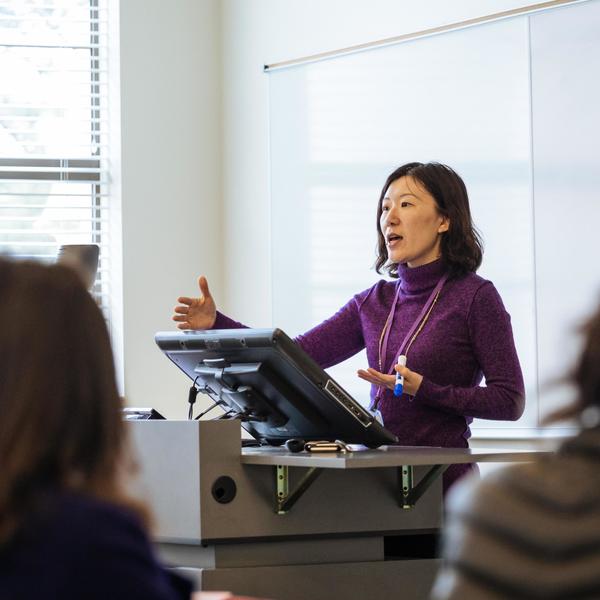
The Economics major gives students a rich education in economic theory and empirical applications. Students begin by acquiring a deep foundation in microeconomics and macroeconomics and in econometrics, then take courses in specialized areas, including international trade and finance, poverty and discrimination, behavioral economics and labor economics, among others. You'll learn:
Omicron Delta Epsilon, the International Economics Honor Society, strives to recognize scholastic attainment in economics and establish closer ties between students and faculty in economics. The Agnes Scott chapter meets these objectives by engaging in various activities around campus including an occasional economics discussion over lunch, social events, seminars, and field trips to places such as the Federal Reserve Bank.
The Economics Learning Center offers a welcoming learning environment for students who need assistance in economics classes. Students can get help from a professor or a learning assistant on a problem set, study with classmates, prepare for an upcoming exam, or use the computers, which have Excel, Stata, and StatTransfer for working on economics problem set or research project. Learning assistants and faculty members are available Monday through Friday. Students are encouraged to drop in and work by themselves, with other students, or with a learning assistant.
The department strongly encourages majors to complete at least one internship while at Agnes Scott. Internships are an important way for students to gain insight into future careers, begin to establish a network of professional contacts, and learn how businesses or nonprofit organizations operate. Agnes Scott students have completed internships at many different organizations in Atlanta and around the United States. In the last few years, students have interned at AT&T, Turner Broadcasting, UPS, Morgan Stanley, the Centers for Disease Control and Prevention, the Carter Center, Georgia Public Broadcasting, Amnesty International, Merrill Lynch, the Atlanta Symphony, Gather Technologies, and the Southern Company, among many other organizations.
With the hands-on, experiential learning inherent in the economics major, you will acquire a well-rounded skill set that prepares you for professional work, or further study.
The economics major at Agnes Scott will prepare you for a career in business or non-profit fields by providing a thorough background in economic theory and applications. Some of our students choose go on to graduate programs in economics or public policy while others go to law school. Some return to school to get an MBA after working for few years.