
(Last revised: July 21, 2009)
In the late 1630s, Pierre de Fermat (1601-1665) wrote a marginal note in his copy of Claude Bachet's Latin translation of Diophantus's Arithmetica that was to intrigue mathematicians for the next 300 years.
"It is impossible to separate a cube into two cubes, or a biquadrate into two biquadrates, or in general any power higher than the second into two powers of like degree; I have discovered a truly remarkable proof which this margin is too small to contain."
In modern symbolic notation, which Fermat did not have available to him, this claim is known as
Fermat's Last Theorem (FLT):
xn + yn = zn
has no positive integer solutions for x, y, z when n > 2
We now know, of course, that Fermat's Last Theorem is true for every value of n > 2 thanks to the crowning work of Andrew Wiles, first described in 1993 and then published in 1995. But as L.E. Dickson wrote in 1917,
This challenge problem has received attention of many mathematicians of the highest ability, including Euler, Legendre, Gauss, Abel, Sophie Germain, Dirichlet, Kummer and Cauchy.
Quite a list of distinguished mathematicians! It is interesting that Dickson gave the first name of only one person on this list. Perhaps it was because of all the names given, he felt that Sophie Germain would be the least recognized by most readers. But indeed, Sophie Germain was one of the first to provide a grand plan for proving Fermat's Last Theorem, and to give a partial solution for a large class of exponents.
The case n = 4 had been settled by Fermat when he used his method of infinite descent to prove that the area of a right triangle with rational sides is never a perfect square, a condition that is equivalent to the claim that there are no integer solutions to x4 + y4 = z2, and hence no solutions to x4 + y4 = z4. Because any integer greater than 2 is either a multiple of 4 or contains a factor that is an odd prime, it therefore suffices to prove FLT for odd prime exponents. For example, if n = 4k has solutions for x, y, and z, then
x4k + y4k = z4k => (xk)4 + (yk)4 = (zk)4
would say there is a solution for n = 4, which we know is impossible. A similar argument shows that if there is no solution for an exponent that is a prime greater than 2, then there is no solution for any exponent containing that odd prime factor.
In 1770 Euler published a proof of FLT for n=3, although the proof is now considered incomplete because one step involving the divisibility properties of integers of a special form was done without sufficient justification. Gauss also gave a proof for n=3 that was not published until after his death. The cases n=3 and n=4 were therefore all that was known at the time that Sophie Germain wrote her first letter to Gauss on November 21, 1804, using the pseudonym Antoine Le Blanc. In her letter, she said
"I add to this art some other considerations which relate to the famous equation of Fermat xn + yn = zn whose impossibility in integers has still only been proved for n = 3 and n = 4; I think I have been able to prove it for n = p-1, p being a prime number of the form 8k+7. I shall take the liberty of submitting this attempt to your judgment, persuaded that you will not disdain to help with your advice an enthusiastic amateur in the science which you have cultivated with such brilliant success."
Unfortunately, her proof was incomplete, although Gauss made no mention of this in his response to Germain's letter. See the article [2, p.353] by Del Centina for a description of her argument and where it is incomplete.
In 1819, Germain returned to the study of number theory and in a letter to Gauss dated May 12 of that year, she wrote
"Although I have labored for some time on the theory of vibrating surfaces (to which I have much to add if I had the satisfaction of making some experiments on cylindrical surfaces I have in mind), I have never ceased to think of the theory of numbers...A long time before our Academy proposed as the subject of a prize the proof of the impossibility of Fermat's equation, this challenge...has often tormented me."
In this letter she laid out her grand plan to prove Fermat's Last Theorem. Her goal was to prove that for each odd prime exponent p, there are an infinite number of auxiliary primes of the form 2Np+1 such that the set of non-zero p-th power residues xp mod (2Np+1) does not contain any consecutive integers. If there were a solution to xp + yp = zp, then Germain observes that any such auxiliary prime would have to necessarily divide one of the numbers x, y, or z. Her letter and manuscripts found in various libraries showed her analysis for the primes p less than 100 and for auxiliary primes with N from 1 to 10.
For example, suppose we take the case p = 5. Let's also consider N = 1. Then we need to look at the non-zero 5th power residues mod 11. These are
{15, 25, 35, 45, 55, 65, 75, 85, 95, 105} mod 11
= {1, 32, 243, 1024, 3125, 7776, 16807, 32768, 59049, 100000} mod 11
= {1, 10, 1, 1, 1, 10, 10, 10, 1, 10} mod 11
= {1, 10}
Those numbers are not consecutive, so 11 is an auxiliary prime that works for p = 5.
We can try the same thing for N=2, 3, ..., 10:
N = 2 involves mod 21, but 21 is not prime.
N = 3 has 5th power residues {1, 5, 6, 25, 26, 30} mod 31 and this set fails the non-consecutive residue condition. In fact, it can be shown that the condition for non-consecutive power residues will fail whenever N is a multiple of 3.
N = 4 has 5th power residues {1, 3, 9, 14, 27, 32, 38, 40} mod 41 and this set has no consecutive elements.
N = 5 involves mod 51, but 51 is not prime.
N = 6 is a multiple of 3.
N = 7 has 5th power residues {1, 20, 23, 26, 30, 32, 34, 37, 39, 41, 45, 48, 51, 70} mod 71 and this set has no consecutive elements.
N = 8 involves mod 81, but 81 is not prime.
N = 9 is a multiple of 3.
N = 10 has 5th power residues {1, 6, 10, 14, 17, 32, 36, 39, 41, 44, 57, 60, 62, 65, 69, 84, 91, 95, 100} mod 101 and this set has no consecutive elements.
So now we know the auxiliary primes 11, 41, 71, and 101, corresponding to N = 1, 4, 7, and 10, satisfy the non-consecutive 5th power residue condition. Hence according to Germain, this would mean that if there is a solution of Fermat's equation for exponent 5, then one of x, y, or z must be a multiple of 11, one must be a multiple of 41, one must be a multiple of 71, and one must be a multiple of 101. In particular, one of x, y, or z must be a multiple of at least two of these auxiliary primes.
Now remember that Germain's grand plan was to prove that every odd prime p has an infinite number of auxiliary primes satisfying the non-consecutive p-th power residue condition. If that was the case and if x, y, and z were solutions to Fermat's equation for that exponent p, then each of the infinitely many auxiliary primes must divide one of x, y, or z (although not necessarily all the same one.) Looking at the three (possibly overlapping) subsets of auxiliary primes consisting of those that divide x, those that divide y, and those that divide z, at least one of these subsets must itself be infinite. But that would mean that one of the integers x, y, or z would be a multiple of an infinite number of primes, which is impossible, and hence Fermat's equation could have no solutions for that exponent p.
However, as Germain admitted to Gauss, she was unable to establish the existence of an infinite number of auxiliary primes even for a single prime exponent. Indeed, Germain's grand plan was doomed to failure as it was later shown that for each odd prime p there are only a finite number of auxiliary primes that satisfy the non-consecutive p-th power residue condition. Germain, herself, eventually proved in a letter to Adrien-Marie Legendre that for p = 3, the auxiliary primes 7 and 13 were the only ones that worked. Nevertheless, this was the first time anyone had devised a plan to prove Fermat's Last Theorem for infinitely many prime exponents rather than on a case by case basis.
For an odd prime p, if the equation xp + yp = zp is satisfied in integers, then one of the numbers x + y, z – x, or z – y must be divisible by p2p-1 and by the p-th power of all primes of the form 2Np+1 which satisfy the two conditions:
- there are not two consecutive non-zero p-th power residues (mod 2Np+1)
- p is not a p-th power residue (mod 2Np+1)
Notice that condition (1) is the same condition from her grand plan, and now a second condition has been added about p not being a p-th power residue mod 2Np+1. For our example above with p = 5, none of the sets of 5th power residues satisfying condition (1) contain p = 5. Therefore, Germain's claim would imply that for any solution to Fermat's equation for p = 5, one of the numbers x + y, z – x, or z – y must be divisible by 59, 115, 415, 715, and 1015, and hence divisible by the product
(59)(115)(415)(715)( 1015) = 691,053,006,763,356,095,514,121,490,614,455,078,125.
In turn, that would mean that one of x, y, or z would have to have a value at least half of that 39 digit number, which, as Germain wrote Gauss, is a number "whose size frightens the imagination."
Unfortunately, the proof that Germain outlined for her "key theorem" had a few flaws. She later realized that her proof was incomplete and tried to fix it, but was not successful. Indeed, we still know of no proof for her claims. However, one valid conclusion that does survive from her work is that if conditions (1) and (2) hold for some auxiliary prime, then one of x, y, or z is actually divisible by p2. See section 4.1 of the article by Laubenbacher and Pengelley [5] for more details.
Germain's work led to Fermat's Last Theorem being broken into two cases:
FLT I: xp + yp = zp has no integer solutions for which x, y, and z are relatively prime to p, i.e. in which none of x, y, and z are divisible by p;
FLT II: xp + yp = zp has no integer solutions for which one and only one of the three numbers is divisible by p.
While her attempts to complete her grand plan and to prove her "key theorem" were not successful, her work did correctly prove what is now known as Sophie Germain's Theorem. This result was presented by Legendre in an 1823 paper to the French Academy of Sciences and included in a supplement to his second edition of Théorie des Nombres, with a footnote crediting the result to Sophie Germain.
Those two conditions are equivalent to the two conditions in Germain's "key theorem". Many biographies of Sophie Germain and descriptions of her work on Fermat's Last Theorem only say that she proved that Case I holds when p and 2p+1 are both prime (such a prime p is now called a Sophie Germain prime.) Suppose θ=2p+1 is a prime, where p is an odd prime. Then for any number 0 < a < θ, Fermat's Little Theorem implies that (ap)2 = aθ-1 = 1 mod θ. Therefore (ap-1)(ap+1) = 0 mod θ, and since θ is a prime, we must have either ap = 1 mod θ or ap = -1 mod θ. This means that if x, y, and z are not congruent to 0 mod θ, then
xp + yp + zp = ±1 ±1 ±1
which can never equal 0 mod θ. Hence condition (1) in Sophie Germain's theorem is true. Moreover, it is impossible for xp = p mod θ to have a solution, establishing condition (2) in Sophie Germain's theorem.
But Germain actually proved much more in the course of trying to establish her grand plan, showing that if the number 2 is not a p-th power residue mod θ, then condition (1) holds when p is a prime and the auxiliary prime θ is of the form 4p+1, 8p+1, 10p+1, 14p+1, or 16p+1. By calculating the exceptional cases when 2 is a p-th power residue mod θ, she was able to find the auxiliary primes of the form 2Np+1 satisfying condition (1) for values of N between 1 and 10 and odd prime exponents p less than 100. Later, in her attempt to prove her "key theorem," she showed that each of these auxiliary primes also satisfies condition (2) above.
In his 1823 paper, Legendre, using different techniques than Germain, showed that conditions (1) and (2) hold whenever p is a prime and 4p+1, 8p+1, 10p+1, 14p+1, or 16p+1 is also a prime. While Legendre has usually been credited with this more general result, the recent articles by Andrea Del Centina [2] and by Reinhard Laubenbacher and David Pengelley [5] show how Germain independently derived the same conclusions in her personal manuscripts for p < 100 and N ≤ 10.
With their analysis, Germain and Legendre were collectively able to show that all prime exponents less than 197 satisfy Case I of Fermat's Last Theorem. The following table gives an auxiliary prime θ=kp+1 that satisfies Sophie Germain's theorem for each of the primes less than 197. The entries in blue are the Sophie Germain primes. You can see why Germain and Legendre stopped at 197. The first prime that works for p=197 is p=7487=38·197+1 and this was not covered by the analytic results Germain and Legendre had derived. If you wanted to verify that θ = 7487 worked by brute force computation like we did with p = 5, you would have to deal with some very large numbers and computer algebra systems would not be invented for another 175 years or so.
| p | θ=kp+1 | k | p | θ=kp+1 | k | p | θ=kp+1 | k | p | θ=kp+1 | k | |||
|---|---|---|---|---|---|---|---|---|---|---|---|---|---|---|
| 3 | 7 | 2 | 5 | 11 | 2 | 7 | 29 | 4 | 11 | 23 | 2 | |||
| 13 | 53 | 4 | 17 | 137 | 8 | 19 | 191 | 10 | 23 | 47 | 2 | |||
| 29 | 59 | 2 | 31 | 311 | 10 | 37 | 149 | 4 | 41 | 83 | 2 | |||
| 43 | 173 | 4 | 47 | 659 | 14 | 53 | 107 | 2 | 59 | 827 | 14 | |||
| 61 | 977 | 16 | 67 | 269 | 4 | 71 | 569 | 8 | 73 | 293 | 4 | |||
| 79 | 317 | 4 | 83 | 167 | 2 | 89 | 179 | 2 | 97 | 389 | 4 | |||
| 101 | 809 | 8 | 103 | 1031 | 10 | 107 | 857 | 8 | 109 | 1091 | 10 | |||
| 113 | 227 | 2 | 127 | 509 | 4 | 131 | 263 | 2 | 137 | 1097 | 8 | |||
| 139 | 557 | 4 | 149 | 1193 | 8 | 151 | 1511 | 10 | 157 | 1571 | 10 | |||
| 163 | 653 | 4 | 167 | 2339 | 14 | 173 | 347 | 2 | 179 | 359 | 2 | |||
| 181 | 1811 | 10 | 191 | 383 | 2 | 193 | 773 | 4 | 197 | 7487 | 38 |
Auxiliary primes p=kn+1 satisfying Germain's Theorem for p
The observant reader might notice that the claim about when Case I holds did not include auxiliary primes of the form θ=6p+1 or the form θ=12p+1, and that, indeed, in the table above, the values k=6 and k=12 never appear. The reason for this is that a prime of the form θ=6mp+1 will never satisfy condition (1) of Sophie Germain's theorem [Proof]. For example, suppose p=5 and θ=31=6·5+1. Let x=1, y=9, and z=81. None of these three integers is equal to 0 mod 31, but
15 + 95 + 815 = 3486843451 = 112478821·31 = 0 mod 31
These three integers therefore violate the requirement of condition (1).
Given an odd prime p, how can one find an auxiliary prime θ satisfying the two conditions in Sophie Germain's Theorem? One way to proceed is is to make use of a theorem by Euler.
Euler's Theorem: Let θ be a prime and let 0 < a < θ. Then xp = a mod θ has a solution if and only if a(θ-1)/d = 1 mod θ, where d = (p, θ-1) is the greatest common divisor of p and θ-1.
Now suppose p and θ-1 are relatively prime where θ > p, so d=1. Then Euler's theorem would say that xp = a mod θ has a solution if and only if aθ-1 = 1 mod θ. But this last condition holds for all values of a less than θ by Fermat's Little Theorem. In particular, there is a solution to xp = p mod θ. Hence condition (2) is not satisfied for any prime θ for which (p,θ-1) = 1. This means that it is only necessary to look at possible candidates of the form θ = kp+1, as Sophie Germain and Legendre did. Moreover, if k is odd, then kp+1 would be even (remember that p is an odd prime), hence not a prime. Therefore one needs to only look at cases where k is even, k is not a multiple of 6, and θ=kp+1 is prime.
So consider the case when θ=kp+1. Then d=(p,θ-1)=p and (θ-1)/d = k. To see if condition (2) holds for θ, it is only necessary to calculate pk. If the result is not equal to 1 mod θ, then there is no solution to xp = p mod θ. This is similar to what Germain did, but what she did was more clever. See Laubenbacher and Pengelley [5] for details.
Checking condition (1) is aided by the following observation.
Theorem: Condition (1) of Sophie Germain's theorem holds for the prime p and the auxiliary prime θ if and only if the set of non-zero p-th powers mod θ does not contain two consecutive integers. [Proof]
By Euler's theorem, the set of non-zero p-th powers mod θ has the same number of elements as the set of solutions to the equation ak = 1 mod θ. But since k is a divisor of θ-1, a theorem of number theory allows us to conclude that the number of non-congruent solutions to this equation is exactly k. Therefore there are exactly k non-zero p-th powers mod θ. Moreover, because p is odd, these power residues come in pairs of positive and negative values since ap = -(θ-a)p mod θ. For example, suppose we take p=47 and θ=47*6+1=283. The following Mathematica code computes a47 mod 283 for a=1 up to a=282.
In[78]:= Table[PowerMod[a,47,283],{a,1,282}]
Out[78]=
  {1,282,239,1,45,44,238,282,238,238,238,239,238,45,1,1,45,45,282,45,282,45,44,
  44,44,45,282,238,1,282,239,282,282,238,239,238,45,1,282,238,44,1,282,238,
  239,239,45,239,44,239,1,238,282,1,239,45,44,282,238,1,1,44,44,1,239,1,282,
  45,45,44,1,45,238,238,45,282,44,1,282,45,44,239,44,282,44,1,239,45,238,44,
  44,44,238,238,238,44,238,239,44,44,44,282,44,45,238,1,45,282,239,44,1,238,
  44,239,282,1,44,45,239,282,44,282,45,239,282,239,1,282,44,44,282,282,45,1,
  238,238,238,238,45,239,1,282,44,238,45,45,45,45,282,238,1,1,239,239,1,282,
  44,1,44,238,1,239,1,44,238,239,282,1,44,239,45,282,239,44,1,238,282,45,238,
  239,1,239,239,239,44,45,239,45,45,45,239,239,239,45,238,44,282,239,1,239,44,
  239,238,1,282,239,1,238,45,45,238,282,239,238,238,1,282,44,282,239,239,282,
  282,45,1,239,238,44,282,1,45,282,44,239,44,238,44,44,45,1,282,239,45,1,282,
  238,45,44,45,1,1,44,1,282,45,1,238,239,239,239,238,1,238,1,238,238,282,282,
  238,45,44,45,45,45,1,45,239,238,282,44,1,282}
We see there are many repetitions! The set actually reduces to just the six elements {1, 44, 45, 238, 239, 282} = {±1, ±44, ±45} mod 283. The only powers we really need to check are {1, 44, 45} and in this set we see that there are two consecutive integers. Therefore condition (1) of Sophie Germain's theorem does not hold for p=47 and θ=283. In particular,
(247 + 347 + 547) mod 283 = (-1 + -44 + 45) mod 283 = 0 mod 283
Of course, we should have already expected this because θ is of the form 6p+1. Now take p=47 and θ=47*14+1=659. This time we will not list the 47th powers mod 659 of all the integers from 1 to 658. The set of distinct residues is {±1, ±12, ±55, ±144, ±249, ±270, ±307}. This set does not contain two consecutive integers, so condition (1) does hold for this auxiliary prime θ.
Both conditions (1) and (2) are easily checked with a computer. For example, here is some Mathematica code that will search for an auxiliary prime for a given prime integer p. [Note: in this code t takes the role of θ]
g[x_,t_] := t/2 - Abs[x-t/2]

SG1[p_,k_] :=
  Module[{A={}, t=k*p+1},
      For[a=1, Length[A] < k/2, a++, A=Union[A,{g[PowerMod[a,p,t],t]}]];
      FreeQ[Drop[A-RotateRight[A],1],1]
  ]

SG2[p_,k_] := Not[PowerMod[p,k,p*k+1]==1]

SGCheck[p_Integer] :=
   Module[{k=2},
      While[ If[Mod[k,6]>0 && PrimeQ[p*k+1],(k<100) &&!(SG2[p,k]  && SG1[p,k]),
          True],k=k+2];
      p*k+1
   ] /; PrimeQ[p]
The function g simply converts the residues larger than t/2 to the corresponding positive residues less than t/2. The function SG1 checks to see if the set of non-zero p-th powers mod t=kp+1 contains two consecutive integers by subtracting consecutive elements in the ordered set of residues and looking for the value 1. It thus returns the value TRUE if condition (1) of Sophie Germain's theorem holds for t. The function SG1 stops computing the p powers mod t as soon as it finds a set of size k/2 of positive residues less than t/2. The function SG2 returns the value TRUE if the statement pk = 1 mod t is FALSE, i.e. if condition (2) of Sophie Germain's theorem holds for t. Finally, SGCheck takes a prime integer t and checks each prime t=kp+1 (for k an even integer that is not a multiple of 6) until it finds a value of k for which both conditions in Sophie Germain's theorem are true. It only searches for k < 100, however, since there is no guarantee in Sophie Germain's theorem that an auxiliary prime will always exist.
In his 1823 memoir, Legendre verified Case II for p = 5, including that result in a supplement to the second edition of his book on number theory in 1825. Also in 1825, Peter Lejeune Dirichlet independently verified Case II for p = 5. Thus Fermat's Last Theorem held for p = 5. In 1839, Gabriel Lame proved Case II for p = 7, thus showing that Fermat's equation has no solution for that exponent.
The Italian mathematician Count Guglielmo Libri had first claimed in 1829 that for a given prime p, there cannot be more than a finite number of auxiliary primes θ that satisfy the two conditions in Sophie Germain's theorem. A. E. Pellet showed in 1886 that Libri's claim was correct, but could not specify a bound for the values of θ that might satisfy the conditions in the theorem. In 1909, L.E. Dickson provided a second proof of the conjecture by showing that if p and θ are odd primes such that
θ > (p - 1)2(p - 2)2 + 6p - 2
then the congruence xp + yp + zp = 0 mod θ always has integer solutions that are each relatively prime to θ, thus violating condition (1) of Sophie Germain's theorem. For example, if p=5, then this happens for θ > 172. If we take θ=5·38+1=191, then the set of 5th powers mod 191 is
{1,5,6,11,25,30,31,32,36,37,38,41,52,55,66,69,70,84,107,121,122,125,
136,139,150,153,154,155,159,160,161,166,177,180,185,186,190}
which contains several sets of consecutive integers, so condition (1) fails for this value of θ.
A year earlier, in 1908, Dickson proved that if p and θ=kp+1 are odd primes with k not a multiple of 6 and with k
< 27 (except for 7 special cases), then condition (1) of Sophie Germain's
Theorem always holds for this p and θ. These
special cases are
p = 3 : k = 10, 14, 20, 22, 26
p = 5 : k = 26
p = 31 : k = 22
Dickson [7] was also able to show that all odd primes less than 7000 satisfy the first case of Fermat's Last Theorem except for the prime p = 6857, of which he wrote that "I have not taken the trouble to treat this case". In 1941, the mathematician Emma Lehmer and her husband [22] proved that the first case holds for all primes less than 253,747,889.
In 1951, P. Dénes [24] proved that if p is an odd prime and kp+1 is a prime, where k is not a multiple of 6 and k ≤ 100 or k = 110, then the first case of Fermat's Last Theorem is true for the exponent p. Fee and Granville [17] extended the upper limit to k ≤ 200 in 1991. It is not necessarily the case, however, that conditions (1) and (2) in Sophie Germain's theorem hold for all these primes.
In 1985 D.R. Heath-Brown, E. Fouvry, and M. Adelman proved that there are infinitely may primes p for which the first case of Fermat's Last Theorem holds. E. Grosswald wrote in Mathematical Reviews that "The tools used, or quoted, in the proof are rather formidable and comprise, among others, a (very particular case of a recent) theorem of Faltings, old theorems of Sophie Germain and of Wieferich and Mirimanoff, and a generalization of Sophie Germain's theorem..."
So 150 years after Sophie Germain died, her mathematical results were still being used.
A prime number p such that 2p+1 is also prime is now called a Sophie Germain prime. Mathematicians are intrigued by finding large numbers, especially large prime numbers. The record for the largest known Sophie Germain prime (as of February 2016) is 2618163402417×21290000–1, a number with 388342 digits.
There actually are applications for Sophie Germain primes in number theory and even in cryptology for digital signatures based on the Diffie-Hellman key agreement algorithm, so finding large Sophie Germain primes is actually a worthwhile pursuit. In addition, developing the mathematics and computer algorithms to search for and verify large primes is an active area of research. It is not known whether there are an infinite number of Sophie Germain primes, a conjecture that has been called "closely related" to the Twin Primes conjecture by Daniel Shanks in his book on Solved and Unsolved Problems in Number Theory.
Here's another record. The largest palindromic Sophie Germain prime is the following 1047 digit number found by Harvey Dubner, a retired electrical engineer and computer systems designer who used four especially designed personal computers in his home and two more at his son's home:
p = 10...05321812350...01
where each ... gap represents 516 additional 0's. But there's an aesthetic problem with this number — 2p+1 is prime, but is not a palindrome! So here's another example, also found by Dubner:
P = 1919191918090908081808090908191919191
Q = 2P+1 = 3838383836181816163616181816383838383
R = 2Q+1 = 7676767672363632327232363632767676767
All three of these numbers are prime and all three are palindromes! Both P and Q are therefore Sophie Germain primes. It is impossible, however, to have a sequence P, Q, R of three odd Sophie Germain primes that are all palindromes (of two digits or more) because 2R+1 would always end in 5 in such a sequence and thus would not be a prime. Here is the largest known sequence of three such numbers, also found by Harvey Dubner:
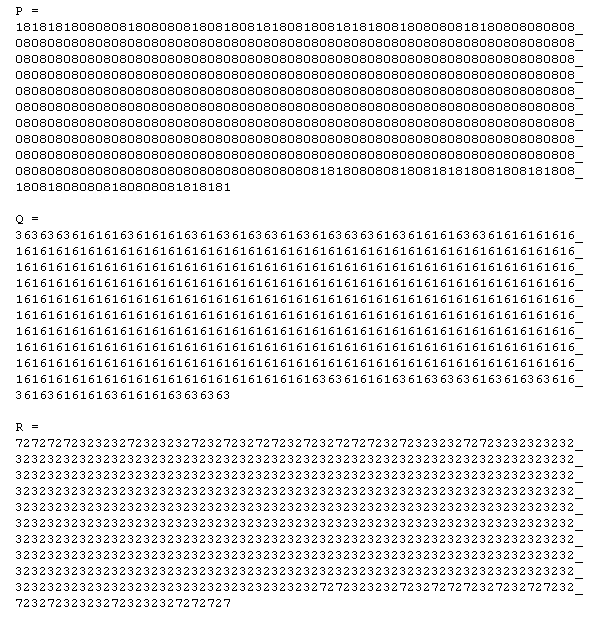
The really fascinating coincidence about his example is that each of these three palindromic primes has 727 digits, and 727 is itself a palindromic prime!
An excellent reference about Sophie Germain's work with Fermat's Last Theorem can be found in Mathematical Expeditions, Chronicles by the Explorers, by Reinhard Laubenbacher and David Pengelley, published by Springer in 1999. Section 4.4, pages 185-193, discusses "Germain's General Approach." This excerpt is available at Pengelley's web site for the book. In addition, chapter 4 of the book Fermat's Last Theorem for Amateurs by Paulo Ribenboim [10] is about Sophie Germain's Theorem.
To read a more detailed reassessment of Germain's work in number theory, see the fascinating article [5] by Laubenbacher and Pengelley called "'Voice ce que j'ai trouvé:' Sophie Germain's grand plan to prove Fermat's Last Theorem," available at https://sites.google.com/view/davidpengelley/david-pengelley and at ArXiv. Their findings are also described in a 2008 two-part series in Science News Online called "An Attack on Fermat", by Julie Rehmeyer. Andrea Del Centina [2] has also published an article about the "Unpublished manuscripts of Sophie Germain and a revaluation of her work on Fermat's Last Theorem".
Watch a Zoom presentation by David Pengelley about "Sophie Germain's Grand Plan to Prove Fermat's Last Theorem", sponsored by the Oregon State University chapter of the Association for Women in Mathematics on May 11, 2020.